Showing posts with label Surveys. Show all posts

Friday, June 06, 2008

Overall youth gambling down, but Internet's lure draws concern, DHS reports

Oregon DHS News Release, 5/29/08

General contact: Ken Palke, 503.947.5286
Program contact: Wendy Hausotter, 503.945.9703

Overall youth gambling down, but Internet's lure draws concern, DHS reports

One of every 20 Oregon adolescents may be a problem or at-risk gambler and many youngsters are being drawn to free gambling-type games on the Internet, according to a recent study sponsored by the Oregon Department of Human Services (DHS).

The study findings, which are in a report titled "Oregon Youth and Their Parents: Gambling and Problem Gambling Prevalence and Attitudes," will be used to refine and develop Oregon's model problem gambling prevention programs.

Oregon's techno-savvy youth indicate that they're gambling for free on the Internet. Many are playing less poker, which used to be the number one gambling activity among youngsters.

"The emergence of free gambling on the Internet is no surprise, but is of real concern," said Paul D. Potter, DHS problem gambling services manager. "Ads for online games pop up, and kids think that if money's not involved there's no risk.

"Kids don't realize they're being primed to play for money later, which is illegal. They can also become a victim of identity theft," he said. "Parents need to be vigilant about their kids' Internet use."

Despite the increase in Internet play, gambling among Oregon 12- to 17-year-olds has declined significantly in the past decade, primarily due to a change in attitudes about young people and gambling.

"When parents learn more about the potential risks of youth gambling, they do a better job of helping their kids make different choices about using their leisure time," said Potter. "Our statewide and local prevention and awareness efforts are paying off, especially when you realize that during the same decade opportunities to gamble have increased."

Potter said Oregon's awareness-raising job isn't finished, because the survey shows that despite evidence to the contrary, most parents and kids still don't see gambling as a behavior that can lead to serious problems, even addiction.

In the past 10 years the number of youths playing the Lottery has declined 80 percent. Potter praised the vigilance of casinos and the Oregon Lottery in helping to reduce underage gambling.

"Selling to anyone under the age of 18 is a violation of a retailer's contract with the Lottery and could put the business's ability to sell our games in jeopardy," said Carole Hardy, Oregon Lottery assistant director for marketing. "We are diligent about providing our retailers with training about the perils of underage play and other responsible selling programs."

According to the study, parents who gamble become role models in their households. Chances are double that their children will become at-risk gamblers and four times as likely that they will become problem gamblers.

Approximately 1.3 percent of Oregon adolescents are problem gamblers, which is narrowly defined as having an extreme pattern of behavior. Another 4.6 percent score as at-risk gamblers, which means that several risk factors are present. Young people who gamble are more likely to use alcohol and drugs, get into fights, skip school and engage in other risky behaviors, according to the study.

"When we hear parents say, ‘What's the harm in kids playing poker? At least I know where they are. They could be doing much worse things.', it tells us that they haven't seen the real data," said Potter. "If they did, they'd think twice."

Oregon parents and children in 1,550 families were interviewed by researchers from May to August 2007. The study found that 63 percent of adolescents gambled at least once, 46 percent gambled in the past year and three percent gamble weekly or more often. Boys gamble on a more regular basis than girls, and older teens are more likely to gamble regularly than younger ones.

The report recommends these improvements to awareness and prevention programs for youth gambling:

  • Use alternative approaches to help Oregon youth with gambling problems, such as teaching parents, teachers, counselors and other youth workers to understand that youth gambling is a problem and recognize its symptoms.
  • Integrate problem gambling information into existing school-based curricula on healthy choices and addictions.
  • Target awareness efforts to athletic coaches and similar groups because of higher problem gambling rates among school sports participants.

Information on problem gambling is available on the Web at 1877mylimit.org.

To reach the free and confidential Oregon Problem Gambling Hotline, call 1-877-MY-LIMIT or visit 1877mylimit.org.

Tuesday, May 27, 2008

Survey: Free online gambling puts teens at risk

Source: Oregon's Statesman Journal, May 27, 2008

Survey: Free online gambling puts teens at risk

Perceived as safe, it can groom youths for wager activities

By Eunice Kim, Statesman Journal

Sex. Drugs. Alcohol. They're all topics that parents, teachers and community leaders tend to talk to children about in hopes of preventing risky behavior.

But there is another issue officials think should be discussed: online gambling.

Gambling for free on the Internet has become the most popular gambling activity among youths in Oregon, according to a new survey.

That concerns officials who say it introduces teenagers to gambling and grooms them for other forms in which money is waged.

"You're learning that gambling is fun, it's stimulating, and it's risk-free," said Wendy Hausotter, problem gambling prevention coordinator with Oregon Department of Human Services. "That's not true at all."

There's an estimated 1,700 gambling sites on the Internet that offer everything from casino-type gambling to poker to bingo. Many offer the option of gambling for free or for money.

The survey, commissioned by DHS last year, found that 33 percent of youths ages 12 to 17 — an estimated 94,659 teens — gamble online for free.

It's an activity that is convenient and easily accessible, officials say, because it can be done at home at any time, often under no supervision from parents. Its novelty, high level of stimulation and low level of physical exertion also appeal to youths, many of whom are tech-savvy.

"It's the game of choice among youth, which is surprising for us," Hausotter said. "It wasn't on the radar screen."

The last survey done on youth gambling in Oregon was in 1998. It didn't ask teens and their parents about free online gambling.

At the time, waging money on card games such as poker was the most common type of gambling among Oregon youths. It's now a close second.

Gambling on the Internet for money, which is illegal, has remained fairly unpopular, with less than 1 percent of teens participating last year, officials said. Overall, gambling among youths has gone down in the past 10 years.

"We're not saying don't gamble," said Yvonne Kays, a prevention health educator with Marion County Health Department. "Our message is, you need to recognize the risk factors and when it becomes a problem … It's a problem when you're spending too much time or money (doing it)."

Gambling, officials said, is when you bet something of value on an event with an uncertain outcome. That something often is money but also can be time, emotion or attention.

The fact that free online gambling doesn't involve money can be a draw for youths, who think they're not doing anything harmful, officials said.

Also, the odds of winning tend to be higher when there's no money waged, Kays said. That can lead kids to think they're lucky or skillful, or that they can win money at other games.

"It disconnects them from the reality of the situation," Hausotter said. "We're afraid that they're going to want to do this more and more. If they do this with money, they're at risk for many things."

That includes loss of money and identity theft, officials said. Online gambling, which is growing in popularity, also is unregulated, so there's no guarantee of a payout.

And even if money is not bet, officials have concerns, given that gambling in general has been correlated with other "risk" behaviors such as drinking.

This year's Oregon Healthy Teens survey found that the percentage of 11th-graders who binge drank, carried a handgun or attacked someone in the past 30 days was higher among those who gambled than those didn't.

Hausotter said state officials plan to meet with gambling prevention specialists next month to figure out how to curb free online gambling and get information out to parents and youth.

In Marion County, the issue already is being addressed in problem gambling prevention presentations given at schools, Kays said. The presentations include a national award-winning youth video that debunks gambling myths.

Deidre Eriksen, a health teacher at Jefferson Middle School, discusses gambling in her health classes along with other risks such as drugs and alcohol abuse. With the Internet, she said, students now can gamble without leaving their homes.

"It's so much more accessible now than it was before," said Eriksen, who received the Outstanding Teacher Participation award last year from the Oregon Problem Gambling Committee. "Now they just have to flip the computer on. It's being inundated in our lives, and we need to learn how to control it."

Statewide, a plan to tackle online gambling likely will be developed this summer in time to hit schools in the fall, Hausotter said. Strategies could include written material and classroom activities.

Internet safety is expected to be a focus, with officials urging parents to pay attention to yet another activity that children could be doing online.

"Just about every kid has a casino in their bedroom if they want," Hausotter said.

ekim@statesmanjournal.com or (503) 399-6721


Survey results
Results of the survey "Oregon Youth and Their Parents: Gambling and Problem Gambling Prevalence and Attitudes" found that:
  • Six in 10 Oregon adolescents surveyed (63 percent) have gambled at some time in their lives
  • 46 percent have gambled in the past year
  • 3 percent gamble once per week or more often

Comparison
Comparing 1998 and 2007 survey results:

  • Gambled in the past year: 66 percent in 1998, 46 percent in 2007 (an estimated 131,949 12-year-olds to 17-year-olds)
  • Gambled on the Internet for free: 33 percent in 2007 (an estimated 94,659 12-year-olds to 17-year-olds)
  • Gambled on the Internet for money: 0.3 percent in 1998, 0.6 percent in 2007 (an estimated 17,210 12-year-olds to 17-year-olds)
  • Gambled via cards: 31 percent in 1998, 32 percent in 2007 (an estimated 91,503 12-year-olds to 17-year-olds)

Getting help

Risk factors
Risk factors for youth problem- gambling include:

  • Living in a single-parent household
  • Being male
  • Living in households with incomes less than the median
  • Playing school sports
  • Having lost more than $50 in a month
  • Starting gambling before entering eighth grade

Tuesday, August 01, 2006

Community gambling survey...

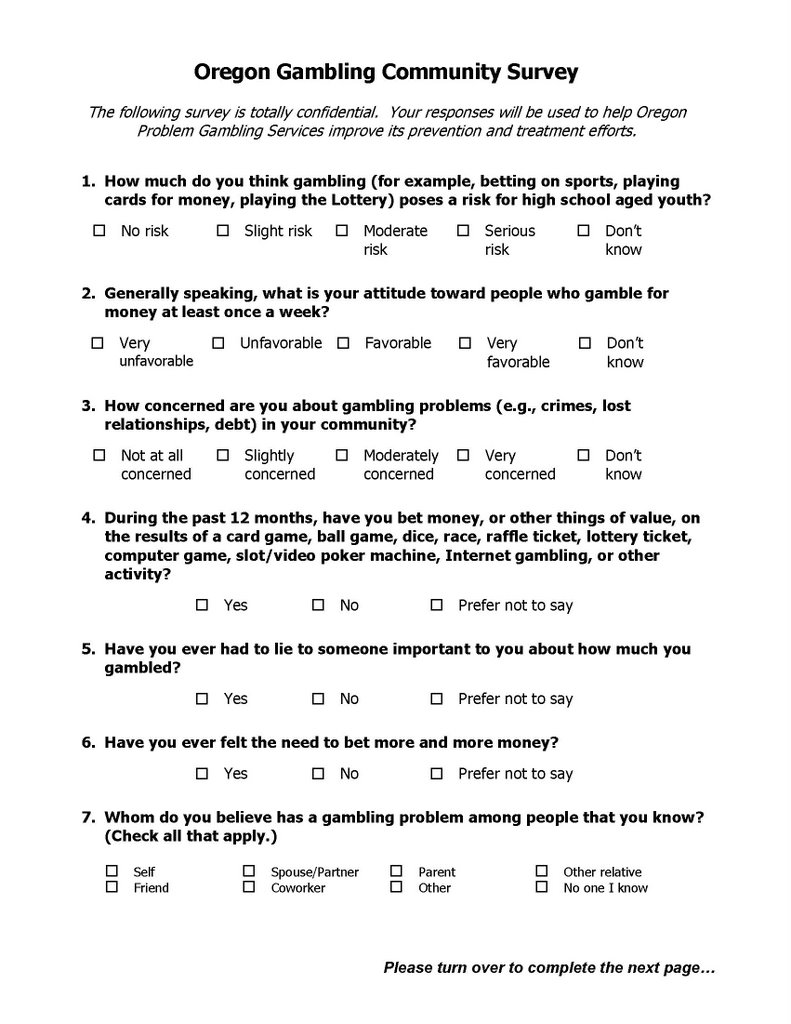
The Oregon Problem Gambling Prevention Committee developed a community survey (right; click to enlarge) about a year ago to address gambling attitudes and behaviors among Oregonians.

The survey also functioned to gain insight to what efforts the general public believes would be important to address for Oregon Problem Gambling Services. A similar survey was developed and conducted among youth, and was highly valuable in understanding the gambling habits & attitudes of almost 2,500 Oregon youth [click here for more info on the youth survey].

To date, only a handful of community surveys have been distributed and returned. In a renewal of efforts, I'd like to see if there is any interest, and what questions we should ask the public.


Questions for any and all:
- What do you believe to be the most important questions in this survey of the general public?
- Do you have any other suggestions for questions in the survey?
- If it were you taking the survey, what length of a survey would you complete? (e.g., 5 questions/one page, etc.)

Post using the "comments" option below. You don't need to use your name, but please list if your profession if applicable. Thanks!